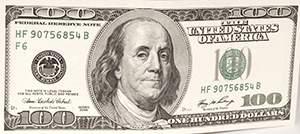
The United States one-hundred-dollar bill, also known as the “Benjamin,” is a valuable piece of currency that holds great significance in American society. Its iconic symbol of wealth and power has been admired and sought after by individuals from all walks of life. Today, we will take a closer look at the evolution of the $100 bill and its cultural impact on the Black community.
The Beginnings
 The $100 bill has a rich history that dates back to its first issuance in 1862 during the Civil War. Initially, it featured a portrait of Benjamin Franklin, one of America’s esteemed Founding Fathers. Franklin, who was an inventor, author, and diplomat, played a crucial role in shaping the early foundations of the United States.
The Evolution
 Over the years, the design of the $100 bill has undergone several changes to incorporate security features and prevent counterfeiting. The latest design, introduced in 2013, showcases a portrait of Benjamin Franklin on the obverse side and an image of Independence Hall on the reverse side.
 One notable aspect of the evolution of the $100 bill is the inclusion of hidden messages and intricate details. These elements add a touch of creativity and intrigue to the design. Some individuals have even taken the time to decode these hidden messages, sparking curiosity and interest in the bill.
Cultural Significance
 The $100 bill holds cultural significance within the Black community in the United States. It represents not only economic empowerment but also a symbol of resilience and progress. Throughout history, African Americans have faced numerous challenges and obstacles, often excluded from economic opportunities. However, the $100 bill represents a tangible representation of success and financial independence.
 In the 1920s and 1930s, the Harlem Renaissance brought forth a cultural explosion of art, literature, and entrepreneurship within the Black community. Notable figures such as Langston Hughes, Zora Neale Hurston, and Marcus Garvey emerged during this era, inspiring future generations of African Americans to strive for excellence.
 In the present day, the $100 bill continues to play a significant role within the Black community. It represents economic empowerment, financial stability, and the ability to overcome systemic barriers. Many successful Black entrepreneurs, professionals, and activists use the $100 bill as a symbol of their achievements and as a reminder of the progress made by the Black community.
Conclusion
 The $100 bill holds both historical and cultural significance within the Black community. It represents the journey towards economic empowerment and serves as a symbol of resilience and progress. As an enduring symbol of wealth and power, the $100 bill continues to inspire and motivate individuals from all backgrounds to strive for success and financial independence.
 As we reflect on the evolution of the $100 bill, let us remember the individuals who paved the way for us and continue to shape our current landscape. The stories of those who fought for economic equality and cultural liberation are woven into the fabric of this currency. Let the Benjamin be a reminder of the progress we have made and the work that still lies ahead.
 Finally, let us use the $100 bill and our collective resources to uplift and empower our communities. By investing in education, entrepreneurship, and economic development, we can ensure a brighter future for generations to come. The $100 bill is not solely a piece of paper but rather a symbol of possibility and the ability to create change.
References:
- United States one-hundred-dollar bill - Wikipedia
- Bad News: Hidden Messages In New $100 Dollar Bill | @vop_Today | 100
- The Evolution Of The $100 Bill | Printable play money, 100 dollar bill
- U.S. $100 bill - Series of 1928 | Dollar bill, Bills printable, Dollar
- 100 dollar bill, Dollar bill, Bills printable
- The Evolution Of The $100 Bill in 2020 | Fake dollar bill, Banknotes
- $100 bill - Google Search | Play money, 100 dollar bill, Dollar bill
- Golden Feather $100 Bill | 100 dollar bill, Dollar bill, Money
- Pin by Jared M on currancy | Dollar money, Money notes, Banknotes money
- Lesson 3.01 When Should I Begin Saving?